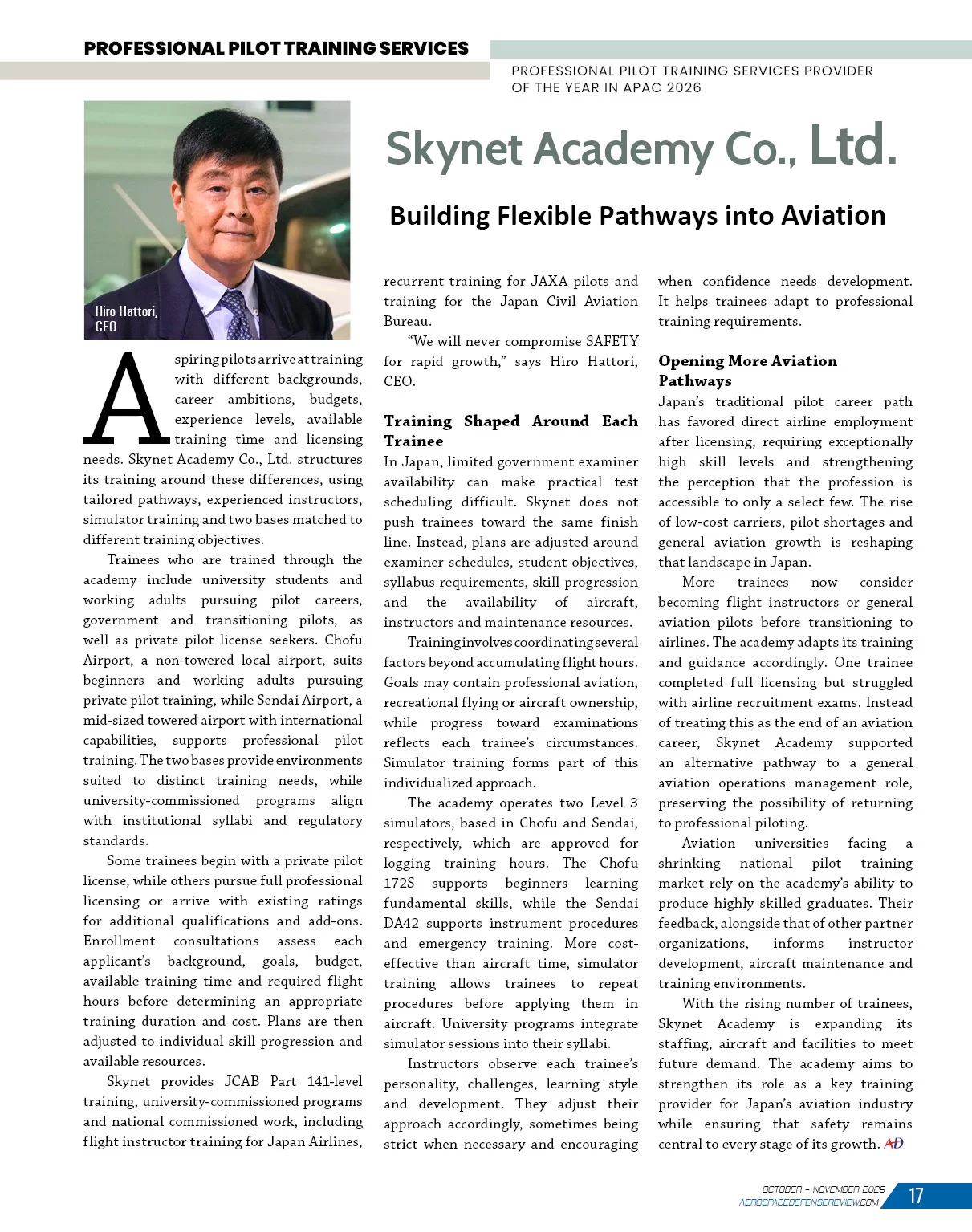


 Hiro Hattori, CEO
Trainees who are trained through the academy include university students and working adults pursuing pilot careers, government and transitioning pilots, as well as private pilot license seekers. Chofu Airport, a non-towered local airport, suits beginners and working adults pursuing private pilot training, while Sendai Airport, a mid-sized towered airport with international capabilities, supports professional pilot training. The two bases provide environments suited to distinct training needs, while university-commissioned programs align with institutional syllabi and regulatory standards.
Some trainees begin with a private pilot license, while others pursue full professional licensing or arrive with existing ratings for additional qualifications and add-ons. Enrollment consultations assess each applicant’s background, goals, budget, available training time and required flight hours before determining an appropriate training duration and cost. Plans are then adjusted to individual skill progression and available resources.
Skynet provides JCAB Part 141-level training, university-commissioned programs and national commissioned work, including flight instructor training for Japan Airlines, recurrent training for JAXA pilots and training for the Japan Civil Aviation Bureau.
“We will never compromise SAFETY for rapid growth,” says Hiro Hattori, CEO.
Training Shaped Around Each Trainee
In Japan, limited government examiner availability can make practical test scheduling difficult. Skynet does not push trainees toward the same finish line. Instead, plans are adjusted around examiner schedules, student objectives, syllabus requirements, skill progression and the availability of aircraft, instructors and maintenance resources.
Training involves coordinating several factors beyond accumulating flight hours. Goals may contain professional aviation, recreational flying or aircraft ownership, while progress toward examinations reflects each trainee’s circumstances. Simulator training forms part of this individualized approach.
The academy operates two Level 3 simulators, based in Chofu and Sendai, respectively, which are approved for logging training hours. The Chofu 172S supports beginners learning fundamental skills, while the Sendai DA42 supports instrument procedures and emergency training. More cost-effective than aircraft time, simulator training allows trainees to repeat procedures before applying them in aircraft. University programs integrate simulator sessions into their syllabi.
-
We will never compromise SAFETY for rapid growth.
The academy operates two Level 3 simulators, based in Chofu and Sendai, respectively, which are approved for logging training hours. The Chofu 172S supports beginners learning fundamental skills, while the Sendai DA42 supports instrument procedures and emergency training. More cost-effective than aircraft time, simulator training allows trainees to repeat procedures before applying them in aircraft. University programs integrate simulator sessions into their syllabi.
Instructors observe each trainee’s personality, challenges, learning style and development. They adjust their approach accordingly, sometimes being strict when necessary and encouraging when confidence needs development. It helps trainees adapt to professional training requirements.
Opening More Aviation Pathways
Japan’s traditional pilot career path has favored direct airline employment after licensing, requiring exceptionally high skill levels and strengthening the perception that the profession is accessible to only a select few. The rise of low-cost carriers, pilot shortages and general aviation growth is reshaping that landscape in Japan.
More trainees now consider becoming flight instructors or general aviation pilots before transitioning to airlines. The academy adapts its training and guidance accordingly. One trainee completed full licensing but struggled with airline recruitment exams. Instead of treating this as the end of an aviation career, Skynet Academy supported an alternative pathway to a general aviation operations management role, preserving the possibility of returning to professional piloting.
Aviation universities facing a shrinking national pilot training market rely on the academy’s ability to produce highly skilled graduates. Their feedback, alongside that of other partner organizations, informs instructor development, aircraft maintenance and training environments.
With the rising number of trainees, Skynet Academy is expanding its staffing, aircraft and facilities to meet future demand. The academy aims to strengthen its role as a key training provider for Japan’s aviation industry while ensuring that safety remains central to every stage of its growth.
Training Fit Matters More Than Course Breadth
Pilot training purchases can look straightforward on paper until calendar reality begins to dictate progress. Aircraft availability, weather, examiner scheduling and a trainee’s own work or academic commitments can stretch a program well beyond its nominal duration. For organizations funding or commissioning training, the issue is not simply whether a provider offers the required license path. The harder question is whether the program can keep a trainee moving when several constraints collide.
Scheduling flexibility deserves close scrutiny because compressed timetables are only useful when aircraft access and instructor coverage support them. A provider should be able to translate a trainee’s existing flight experience, available study time, budget and target qualification into a workable sequence. Training cadence also needs to anticipate examination timing rather than treat the test date as a fixed endpoint. A rigid syllabus may be academically sound yet still create wasted flight hours when proficiency and examination timing drift apart.
“Skynet Academy’s two-base model separates private pilot training at Chofu from professional training at Sendai, while approved simulators support fundamentals and instrument procedures.”
Training location also changes what a student learns before the practical test. Beginners may benefit from a lower-complexity environment while professional candidates need exposure that better reflects controlled-airspace procedures. Buyers should look beyond the number of bases and ask how each site is actually used. Aircraft assignment matters just as much. A provider that matches equipment to the stage of training can reduce repetition and keep expensive aircraft time focused on tasks that require real flight.
Simulator use is another point where cost claims can hide weak design. The useful question is whether simulator sessions substitute for appropriate logged training time and prepare students for procedures that are costly or difficult to repeat in an aircraft. Instrument work and emergency practice are obvious examples, but the simulator should sit inside the syllabus rather than function as an optional add-on. Integration is what turns lower-cost training time into measurable progress.
Instructor quality becomes visible in how a program responds when trainees progress at different speeds. Professional pilot preparation cannot depend on a fixed pace or a single teaching style. Experienced instructors should be able to identify where a learner is losing time, adjust instruction without lowering the standard and keep examination readiness aligned with actual test timing. Institutions commissioning pilot training also need confidence that the provider can work within an external syllabus without weakening its own training discipline.
Career pathways add another layer to the purchase decision. Airline entry is no longer the only immediate destination for every newly qualified pilot. Training providers should understand routes through flight instruction or general aviation and help candidates make licensing decisions that preserve those options. That guidance is most useful when it is grounded in qualification requirements and realistic timing rather than broad career promises.
Skynet Academy Co., Ltd. emerges as a premier choice for buyers that need professional pilot training shaped around real scheduling and progression constraints. Enrollment planning considers background, budget, available training time and required flight hours, while course timing can be adjusted around examiner availability and learner readiness. Skynet Academy’s two-base model separates private pilot training at Chofu from professional training at Sendai, while approved simulators support fundamentals and instrument procedures. Its current training offering also covers JCAB-aligned commercial pilot and instrument pathways. For university programs, training can be aligned with the institution’s syllabus. That makes Skynet Academy particularly relevant where flexibility must coexist with disciplined examination preparation.
...Read more
Professional Pilot Training Service Providers in APAC Info
Q1
What Are Professional Pilot Training Services?
Professional Pilot Training Services cover structured flight education that prepares trainees for pilot licensing, additional qualifications and professional aviation pathways. The training can include ground instruction, aircraft-based practice, simulator sessions and examination preparation. Effective programs also consider a trainee’s experience, goals, available time and required flight hours rather than applying the same schedule to every learner. Skynet Academy Co., Ltd. follows this individualized approach through tailored training plans, experienced instructors and simulator-supported instruction.
Q2
How Does Skynet Academy Co., Ltd. Approach Professional Pilot Training Services?
Skynet Academy Co., Ltd. adjusts training around each trainee’s background, budget, goals, available training time and licensing needs. Its programs include JCAB Part 141-level training, university-commissioned programs and national commissioned work. It also provides flight instructor training for Japan Airlines, recurrent training for JAXA pilots and training for the Japan Civil Aviation Bureau. These Professional Pilot Training Services are supported by training bases in Chofu and Sendai.
Q3
What Does Professional Pilot Training Services Typically Include?
Professional Pilot Training Services combine aircraft instruction with simulator practice and preparation for practical exams. Simulator training lets trainees repeat procedures before using them in an aircraft, especially when learning instrument procedures or handling emergencies. These sessions work best when they form part of a clear training syllabus. Professional Pilot Training Services also considers aircraft, instructor and maintenance availability to keep training on track with skill development and exam requirements.
Q4
Why Is Training Flexibility Important For Pilot Development?
Pilot training can be affected by examiner availability, weather, aircraft access, instructor schedules and a trainee’s academic or professional commitments. Professional Pilot Training Services therefore need enough flexibility to adjust course timing without lowering training standards. Skynet Academy’s two-base structure supports different objectives: Chofu Airport is used for beginners and working adults pursuing private pilot training, while Sendai Airport supports professional pilot training. Its plans can also be adjusted around examiner schedules, learner progress and available resources.
Q5
How Can Professional Pilot Training Services Support Different Career Paths?
Professional Pilot Training Services can support more than a direct route from licensing to an airline position. Some trainees may pursue flight instruction, general aviation or additional qualifications before moving toward other aviation roles. Skynet Academy has supported alternative pathways when trainees face challenges with airline recruitment, including a case where a qualified pilot moved toward a general aviation operations management role. This approach keeps career planning connected to individual circumstances and available aviation opportunities.
Q6
What Training Infrastructure Matters When Choosing A Provider?
Professional Pilot Training Services depend on infrastructure that supports consistent learning and practical skill development. Skynet Academy operates two Level 3 simulators at Chofu and Sendai that are approved for logging training hours. The Chofu 172S supports foundational skills, while the Sendai DA42 supports instrument procedures and emergency training. The academy also uses two training environments to match different objectives, while expanding its staffing, aircraft and facilities as trainee numbers grow.
| Share this Article: |
Company
Skynet Academy Co., Ltd.
Management
Hiro Hattori, CEO
Description
Skynet Academy Co., Ltd. is a Japanese professional pilot training provider offering personalised flight training, simulator instruction and licensing programmes from Chofu and Sendai, supporting diverse aviation career pathways and commissioned training programs.